
Over the past year, I have had a myriad of experiences with professional news sources. I have had the privilege of being able to work with, be a subject for and just simply observe some great organizations at work. Going into these offices and seeing some professionals at the top of their game was inspiring, and many times I felt like I had improved through osmosis. What follows is a list of experiences and things I have gleaned from working with professionals in the field I plan on going into.
My first recent experience with a professional news source was with my internship with WORLD Magazine. While I was still being treated as a student, I was thrown into the field as an actual journalist and had to fend for myself on many stories and prompts. From this, I felt what it was like to be in an environment where my editor was expecting a general story on a tight deadline, and I had to use all the resources at my disposal to meet those expectations. This was different than my experience at college, as at Liberty there is usually a lot of guidance and I am familiar with the territory. In this situation, I was in Sioux City Iowa, with a group of writers who I was not familiar with at all, save Chad Wylie.
I had to figure out story ideas in a place that was not my community, report to professionals who are still in the field, and find others willing to check my work who I did not know very well. This helped breed a lot of self-reliance in my journalistic ability, which I understand is valuable to a degree, but it is also necessary for journalists to work well together.
Thankfully, my internship covered that as well. On two of my projects I was paired with another student in the program. We were assigned larger projects on tight deadlines, which is what I should be expecting in the field. Through this, I was learning how to delegate work, collaborate on ideas, and coordinate schedules well. It was an intense two weeks, but something I would deem very beneficial to my growth as a journalist.
From the internship I then served as a source for an expose WORLD wrote about the newspaper situation at Liberty. I was put in the somewhat uncomfortable position of serving as a source when I was so used to being the journalist in that situation. This benefited me as I realized how I could feel uncomfortable by some questions and how others made me open up. I experienced how much better in-person interviews are for the source as well as the journalist and what it’s like to be hounded when I was not responding, as I was unavailable much of the summer because of my multiple jobs. If anything, I feel like I gained perspective from this.
Next, I had the experience of touring Buzzfeed in New York. Buzzfeed’s Investigations and Special Projects Editor, Ariel Kaminer, reached out to me because of the WORLD magazine article. When we went into the office I had the opportunity to speak with people like investigative reporter Anthony Cormier and Editor in Chief, Ben Smith. These people were exciting, as seeing them work in an environment like that showed me a lot about being a reporter in New York.
The investigative reporters had documents all over their desks, and many of them had different workflows. Some were working together and talking over ideas while others were quietly clicking away with headphones in at their computers. We spoke about the variety of projects they were working on and the crazy situations they find themselves in.
For instance, one investigation into Russia killing off ex-patriots resulted in them almost blowing the cover of someone Russia said was dead. Buzzfeed wrote the article, but the FBI told them that if it was published the man was as good as dead. They held onto the article, and when the BBC published a blurb about it, Buzzfeed was ready to spring into action.
We also spoke about a Buzzfeed reporter who was notorious for his frequent use of the Freedom of Information Act. Apparently, this reporter filed around 20 different requests every day, and was able to mine a lot of information as result.
My next professional experience was through MSNBC, when my staff writer contact from the New Yorker, Adam Davidson, invited me and two others to go to the show. I got the full experience of seeing Morning Joe being set up. The studio was beautiful and was very busy.
Something that stood out to me was how seamlessly everyone worked. This made sense as they were producing this show almost every day but seeing it in action was something else. It’s one thing to be going through the motions of your job, but it’s another entirely to be actively engaged and working harmoniously with your fellow employees on the fly. The workflow was impressive and seeing the high-tension quick pace of the show put morning programs like that in perspective for me.
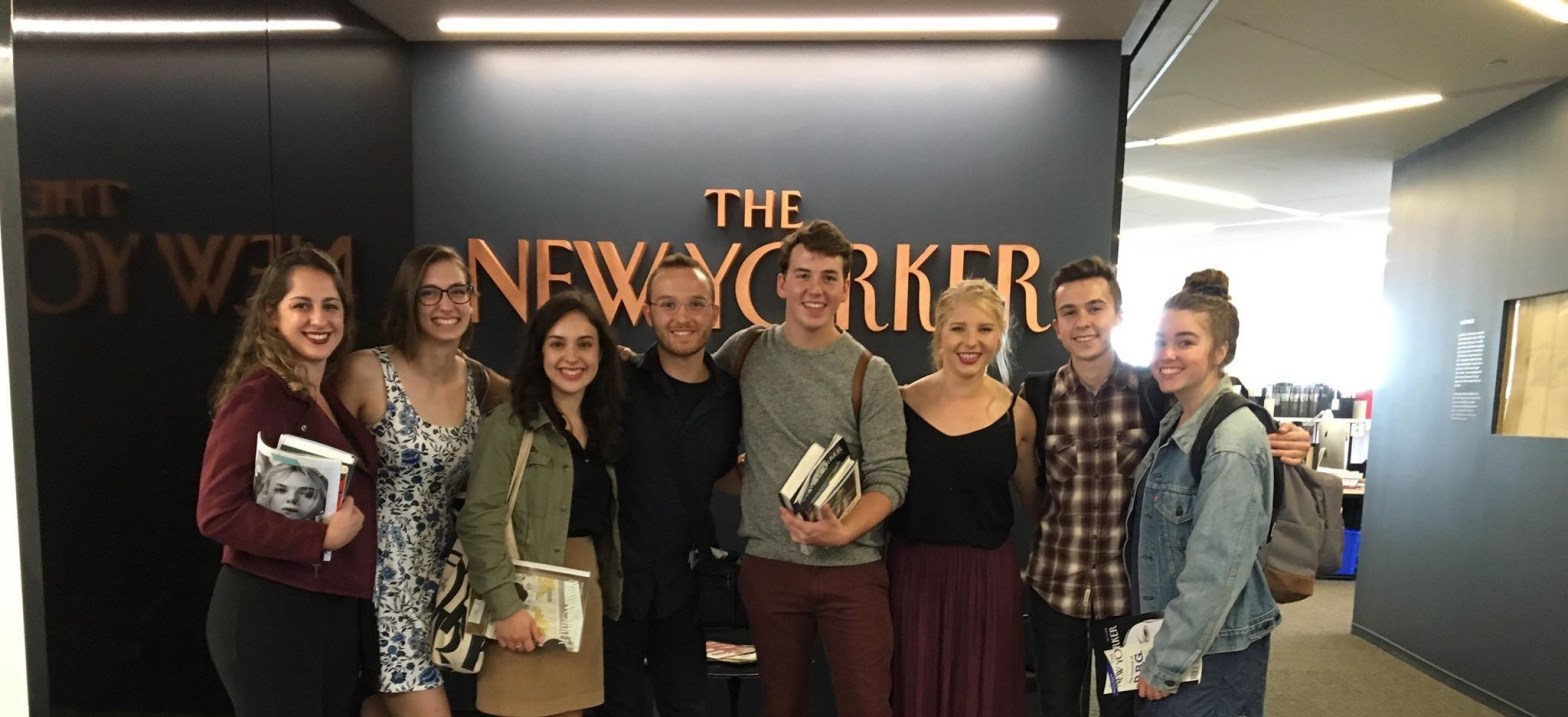
After that we had the opportunity to tour The New Yorker offices with Adam. Going into the offices, we met many of the New Yorker staff writers who were working on a variety of projects. Since the New Yorker is published weekly, and the pieces are generally longform, detailed stories, many writers were in their office with the glass door closed, focused intently on their work. There was a level of focus in those offices that I aspire to.
One writer that stood out to me was Kelefa Sanneh, who had just written a long piece on the endurance of Christian rock. The group talked extensively with him about his research methods and what he had hoped to accomplish in his piece. He told us about when he was researching a band for his piece, he wanted to track how their mission statement changed over the years. He looked everywhere but could not find the band’s originally mission statement. Instead of giving up, he ordered their first CD online and looked in the liner notes. Sure enough, it was there.
Another notable New Yorker we met was Peter Canby. Canby is the head of the fact checking department at the New Yorker. He gave us a rundown of all the hoops each piece has to pass through before getting published in the magazine. This includes multiple reads and re-reads of each piece by multiple people and a small staff of people who are designated as fact checkers. Since the pieces at The New Yorker are so long, each member has to work fast to keep them moving.
Going through The New Yorker showed me a level of detail mixed with an efficiency that I had not seen before. Each member of the team knew what they were doing very well and how they fit into the process. The focus on the stories was impressive, and the pace at which the writers went at left an impression.
What I learned from these experiences, as a writer, source and spectator, is that the journalistic experience changes drastically wherever you are. There is, however, a certain etiquette that all professionals I’ve spoken with have possessed. It’s a quiet intelligence, which makes you assume they know a lot about a lot of things. This didn’t feel like arrogance, but an open mindedness that is hard to pinpoint. This gives me something to aspire to, a goal in poise as well as being adaptable.

